
NABARD Grade A 2026 Preparation Strategy

Anuj Jindal / 20 min read / Last Updated: October 12, 2026
Topics Covered: NABARD Grade A Preparation Strategy, Study Sequence, Important Techniques, Approach to Mocks, DOs & Don’ts, Day-Wise Study Plan, Phase 1 and Phase 2 Study Plans
For someone who plans to work for the agriculture sector, rural institutions, and development programs across the country, the NABARD Grade A exams provide prestigious opportunities.
Each Year many individuals apply for NABARD Grade A exams, which leads to a challenging and intense competition with a limited time to prepare.
To achieve good marks in a highly competitive exam of this level, one requires a well-planned strategy, a well-thought approach, and absolute consistency in preparation. An ideal preparation strategy includes study sequence, a proper timetable, continuous mock tests, and a structured plan for both Phase 1 and Phase 2.
NABARD Preparation is 85% of the game, and the most crucial aspect of your preparation is to have a solid strategy. Every individual has their own niche and differences.
To know more about how to create a good strategy, you can go through this information. In this guide, we are sharing every required detail for you to understand how to prepare for NABARD Grade A exams in an efficient way.
Key Takeaways –
➤ Prepare just to clear the cut-offs in the qualifying section, whereas maximize marks as much as possible in the merit section since only merit determines final shortlisting.
➤ The only difference between NABARD Grade A ESI and RBI Grade B ESI is that NABARD connects every topic to rural areas. Write 3-4 bullet points connecting the topic to rural economy, agriculture, or NABARD to align with exam requirements.
➤ NABARD Grade A Phase 2 is mostly descriptive with a few objective sections, therefore prepare each topic for 200–300-word structured description along with factual detail.
Table of Content – NABARD Grade A
Preparation Strategy 2026
1. Preparation Strategy
1.1 Day-wise Study Plan
1.1.1 Phase 1 – Paper 1
1.1.2 Phase 1 & 2 – Paper 2
1.1.3 How a structured Plan helps
1.2 Study Sequence
1.3 Important Techniques
1.4 Approach to Mocks
1.5 Do’s & Don’ts
1.6 Interview Preparation
1.7 Topper Strategy
What is the best NABARD Grade A 2026 preparation strategy?
NABARD Grade A preparation consists of several aspects that are equally valuable for an effective strategy. We have prepared a dedication section for each aspect below that will not only guide you through preparation topics but also provide a timetable and subject-wise study plan for both phases as well.
Below you can find points that will clear the benefits of a study plan, along with a specifically tailored day-wise NABARD Grade A study plan.
How to Prepare with Anujjindal’s NABARD Grade A Day-Wise Study Plan?
- We have divided the study plan into three organized parts; pick any one accordingly.
- Phase 1 Quant, Reasoning, and English
- Phase 1 Computer Awareness & Decision Making
- Phase 2 ESI & ARD
2. If you have more than 4 months in hand for your prep, you can begin with Phase 1 & 2 ARD and ESI, followed by Phase 1 Computer knowledge & Decision Making and finally Phase 1 QRE. You may also begin with Phase 1 QRE if it is your weak area.
3. Pick up a maximum of 2 subjects in one day, as described in the NABARD study plan. Do not pick up more than 2 subjects at one point.
4. If you are a working aspirant, study in 2 slots – morning and evening. Start your day before other aspirants with the morning targets mentioned in the study plan below.
5. Repeat the cycle after you have completed your syllabus once. In the second reading, start with current affairs too. You need to cover Phase 1 and Phase 2 current affairs together.
NABARD Phase 1 Quant, Reasoning & English – STUDY PLAN
| Quantitative Aptitude | Reasoning | ||
|---|---|---|---|
| Morning | Evening | ||
| Chapters | Days | Chapters | Days |
| Profit & Loss | Day 1 & 2 | Inequalities | Day 1 & 2 |
| Time & Work | Day 3 & 4 | Directions | Day 3 & 4 |
| Ratio & Proportion | Day 5 & 6 | Blood Relations | Day 5 & 6 |
| Average, Mixture & Alligations | Day 7 & 8 | Statements & Assumptions | Day 7 & 8 |
| Time, Speed & Distance | Day 9 & 10 | Statements & Arguments | Day 9 & 10 |
| Quadratic Equation | Day 11 | Statements & Course of Action | Day 11 |
| Quadratic Equation | Day 12 | Coding Decoding | Day 12 |
| Numbers, HCF & LCM | Day 13 | Coding Decoding | Day 13 |
| Numbers, HCF & LCM | Day 14 | Input & Output | Day 14 |
| Data Interpretation | Day 15 | Input & Output | Day 15 |
| Data Interpretation | Day 16 | Arrangements | Day 16 |
| S.I. & C.I. and Partnership | Day 17 & 18 | Arrangements | Day 17 & 18 |
| Percentages | Day 19 & 20 | Number Systems | Day 19 & 20 |
| Ages | Day 21 & 22 | Puzzles | Day 21 & 22 |
| Approximation | Day 23 & 24 | Syllogism | Day 23 & 24 |
| Simplification | Day 25 & 26 | Analogies | Day 25 & 26 |
| English | Reasoning | ||
| Morning | Evening | ||
| Chapters | Days | Chapters | Days |
| Reading Comprehension | Day 27 & 28 | Statements & Conclusion | Day 27 & 28 |
| Cloze Test | Day 29 & 30 | Cause & Effect | Day 29 & 30 |
| Para Jumbles | Day 31 & 32 | Order & Ranking | Day 31 & 32 |
| Common Errors | Day 33 & 34 | Alphabet Test | Day 33 & 34 |
| Phrase Replacement | Day 35 & 36 | Sequence & Symbols | Day 35 & 36 |
| Critical Reasoning | Day 37 & 38 | Classification | Day 37 & 38 |
| Sentence Correction | Day 39 & 40 | Data Sufficiency | Day 39 & 40 |
| Combining Sentences | Day 41 & 42 | ||
| Fill in the Blanks | Day 43 & 44 | ||
| Vocabulary | Day 45 & 46 | ||
NABARD Phase 1 Computer Awareness & Decision Making – STUDY PLAN
| Computer Awareness | Decision Making | ||
|---|---|---|---|
| Morning | Evening | ||
| Chapters | Days | Chapters | Days |
| Principles of Computing | Day 1 | Definitions | Day 1 |
| Software & Its Types | Day 2 | Types of Decisions | Day 2 |
| Networking & Communication | Day 3 | Making Rational Decisions | Day 3 |
| Internet & Security Tools | Day 4 | Making Good Enough Decisions | Day 4 |
| Computer Languages | Day 5 | Making Intuitive Decisions | Day 5 |
| MS Office | Day 6 | Making Creative Decisions | Day 6 |
| Database Management System | Day 7 | Making Faculty Decisions | Day 7 |
| Computer Abbreviation | Day 8 | Decision Making in Groups | Day 8 |
| Tools for Better Decisioins | Day 9 | ||
| Developing Decision Making Skills | Day 10 | ||
NABARD Phase 1 & 2 ARD & ESI – STUDY PLAN
| ARD | ESI | ||
|---|---|---|---|
| Morning | Evening | ||
| Chapters | Days | Chapters | Days |
| Introduction to Agriculture | Day 1 & 2 | National Income Accounting | Day 1 & 2 |
| Agronomy | Day 3 & 4 | Schools of Economic Thought | Day 3 & 4 |
| Classification of Field Crop | Day 5 & 6 | Growth & Development | Day 5 & 6 |
| Factors Affecting Crop Production | Day 7 & 8 | Human Development | Day 7 & 8 |
| Agro Climatic Zones of India | Day 9 & 10 | Sustainable Development | Day 9 & 10 |
| Cropping System | Day 11 & 12 | Nature of Indian Economics | Day 11 & 12 |
| Dry Land Agriculture | Day 13 & 14 | India's Economy before Independence | Day 13 & 14 |
| Seeds | Day 15 & 16 | India from 1947 to 1991 Macro Economy | Day 15 & 16 |
| Precision Farming | Day 17 & 18 | India from 1947 to 1991 Agriculture | Day 17 & 18 |
| System of Crop Intensification | Day 19 & 20 | India from 1947 to 1991 Industry | Day 19 & 20 |
| Organic Farming | Day 21 & 22 | India from 1947 to 1991 Services | Day 21 & 22 |
| Agriculture Extension | Day 23 & 24 | Indian Eco. Post 1991 External Sector | Day 23 & 24 |
| Ecology & Environment | Day 25 & 26 | Economic Reforms | Day 25 & 26 |
| Animal Husbandry | Day 27 & 28 | Indian Eco. Post 1991 Macro-Eco. | Day 27 & 28 |
| Fisheries | Day 29 & 30 | Indian Eco. Post 1991 Agriculture | Day 29 & 30 |
| Soil Science & Conservation | Day 31 & 32 | Indian Eco. Post 1991 Industry | Day 31 & 32 |
| Irrigation & Water Resources | Day 33 & 34 | Indian Eco. Post 1991 Services | Day 33 & 34 |
| Plantation & Horticulture | Day 35 & 36 | Indian Eco. Post 1991 External Sector | Day 35 & 36 |
| Forestry | Day 37 & 38 | Public Debt | Day 37 & 38 |
| Form & Agri Engineering | Day 39 & 40 | Federal Finance | Day 39 & 40 |
| Agro Meterology | Day 41 & 42 | Unemployment | Day 41 & 42 |
| Rural Development | Day 43 & 44 | Demographic Issues | Day 43 & 44 |
| Rural Population in India | Day 45 & 46 | Education | Day 45 & 46 |
| Panchayati Raj Institutions | Day 47 & 48 | Gender | Day 47 & 48 |
| ESI | ESI | ||
| Morning | Evening | ||
| Positive Discrimination | Day 49 & 50 | Other Social Issues | Day 49 & 50 |
| Key International Economic Institutions | Day 51 & 52 | International Economic Issues | Day 51 & 52 |
| Role of Indian Banks & Reserve Bank in Dev. | Day 53 & 54 | Indian Eco. Post 1991 Services | Day 53 & 54 |
| Rural Credit | Day 55 & 56 | ||
How Structured Preparation Helped to Crack NABARD Grade A Exam
Last year, I was teaching a very interesting aspirant who was very mindful, dedicated, and regularly attending every live session. After sticking around in the initial classes, he gradually started being absent, and after some time, he completely stopped appearing in the classes.
When there was only a month left for the examination, I conducted a mock test to evaluate his present preparation condition. Unexpectedly, he scored well in the QRE, GA, Decision-Making, and Computer knowledge section but struggled in the merit section of the exam which includes ESI, ARD, and CA.
I thought he was not serious until he came to me himself, concerned after my feedback on his performance.
He told me that he is a serious aspirant who always wanted to clear the NABARD Grade A exam, but due to personal reasons, he started working a job. Which is why he couldn’t manage to study consistently or attend classes.
The chances of him clearing the exam were very less, but he still had hopes, which encouraged me to make a NABARD study plan for him to cover the syllabus while leaving the job. Let me share how exactly I prepared his study plan, considering his job, limited time in a day, limited days before exam
I included only two aspects mainly in this plan, the merit section and tests. This is how I helped in covering the pending syllabus:
ARD:
ARD has the most weightage in the merit section; that is why I suggested him to cover ARD first with the instructions that I am providing below:
- 4 hours a day, before his work shift started in the morning. This ensured fresh minded study.
- 4 hours should not be divided into any slots; it should be done in one sitting.
- Mobile phones and every other distraction should be out of the room while preparing.
- Based upon the videos’ durations, short notes length, and 21 chapters. I calculated that the ARD syllabus would be completed in 10 days.
ESI:
After dedicatedly completing the ARD syllabus, I told him to move forward to cover ESI now with consider below given points:
- ESI focused heavily on PIB Current Affairs, so the last 6 months’ PIB CA needed to be covered.
- Considering all the aspects just like the ARD section, I told him to repeat the 4 hours of preparation for this section as well. That helped cover 1 month’s PIB in 2 days.
- I removed PIB questions from this study plan, since it could have significantly increased the 4-hour window.
- Advised solving questions in situations like traveling, in office lunch, to not completely miss question solving.
- He covered 6 months’ PIB in just 12 days.
Test, Analysis and Revision
As per the plan, he studied 4 hours a day every day, including weekends, and the plan also consisted of tests and analysis every Sunday-Saturday. 2 hours of test, 2 hours of analysis of the test combined with 4 hours of the merit section preparation, his weekends were not time of resting but the time of hard work.
After completing all the syllabus, 10 days of ARD and 12 days of ESI, he still had a week of left for revision. That is what structured study combined with consistency can help in every situation.
His dedication eventually paid off, even after being left behind. He cleared the NABARD Grade A Phase 1 exam with the right guidance and passion.
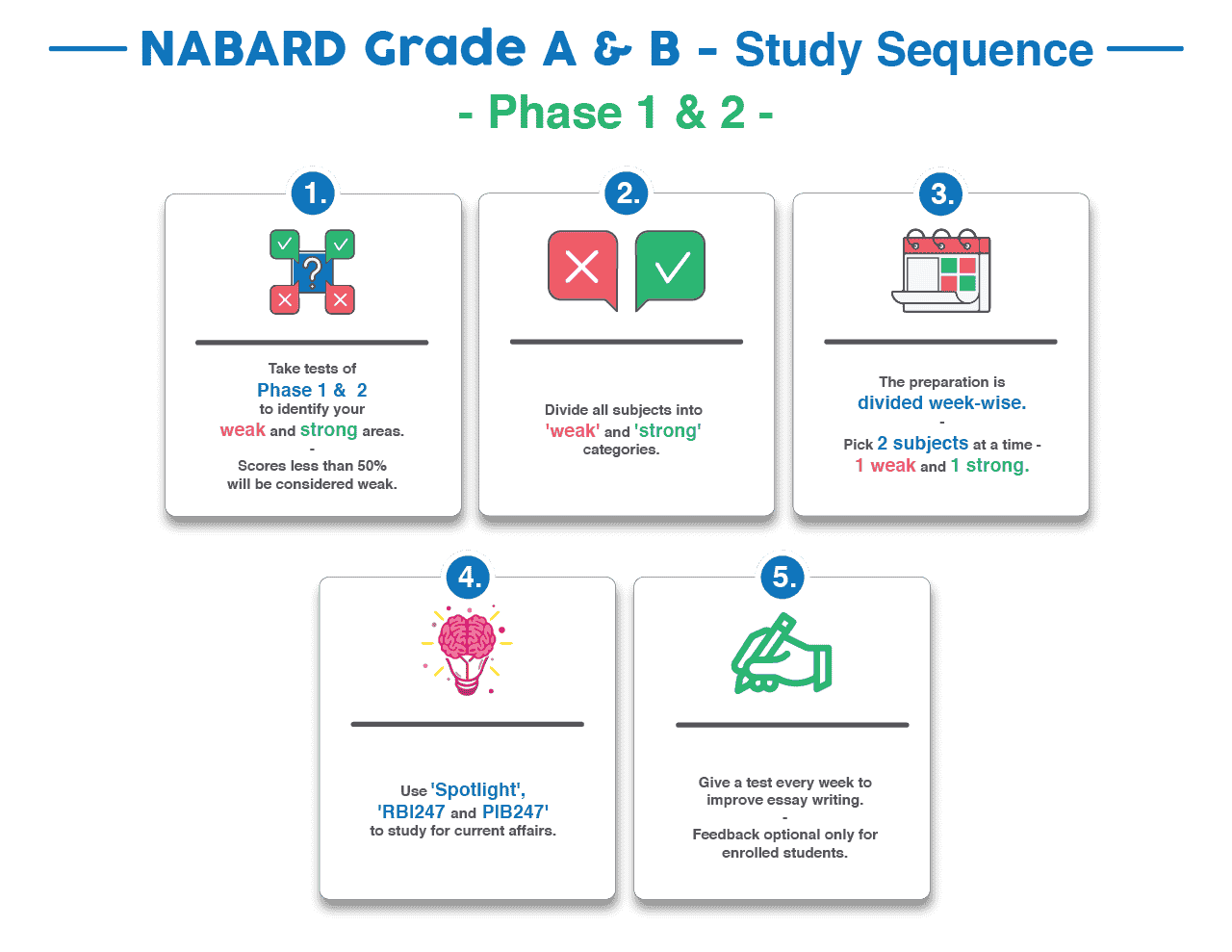
What Should Be the NABARD Grade A Study Sequence?
1. Subject Arrangement: Attempt at least 3 mocks of both Phase 1 and 2 to identify your strong and weak areas. Scores < 50% shall be considered weak.
2. Evaluation: Categorize subjects falling under strong and weak categories after carefully evaluating which of them you are strong in and which of them you are weak in. Be honest.
3. Study Timeline: Divide the preparation time into week-wise phases. Select 2 subjects at a time, one that you are strong in, and the other you are weak in.
4. Brush up on Current Affairs: If you have limited time, start with current affairs when you are done with at-least 50% of your syllabus. Do not begin your preparation with current affairs.
5. Practice Writing: Attempt a test of essays once every week to improve your writing abilities.
What are Important Techniques for NABARD Grade A preparation 2026?
- Consistency: Schedule your day before leaving the bed in the morning and stick to this as far as possible.
- Regular Revision: Revise either daily or weekly, depending on your timetable. Working aspirants can follow a weekly revision schedule, and students can follow a daily revision schedule.
- Previous Year Paper Analysis: Analyze previous year’s paper: It would help in listing the important static part of Subjects and indicate the Shifting trends/Changing patterns.
- Self-Assessment: Always observe yourself, you are the best guide of yourself. You must know where you lack and how much time you need to devote to a topic.
- Newspapers and Magazines: Limit the time spent reading newspapers. Current affairs magazines are more useful before interviews. Argumentation and opinions play a more crucial role during the interview stage. For Phase 1 and Phase 2 You can count on monthly magazines.
What is the right approach to attempting mocks for NABARD Grade A?
1. Weekly Mock Tests:
- Attempting a mock test once every week is essential to improve time management.
- Mocks can be sectional or comprehensive; you can start with sectional tests of NABARD Phase 1 & Phase 2.
- When the examination is 1 month away, you can begin comprehensive mocks.
2. Mock analysis:
- Mock analysis is as important as mocks itself. You can analyze mocks by dividing your answers into 3 parts – correct, incorrect, and not answered.
- You need to identify and improve questions that you answered correctly by luck and the questions that you answered incorrectly.
3. Elimination Technique:
- Work on elimination technique to score higher and also enhance your accuracy. Under elimination, you eliminate all options before finalizing your answer choice.
- It is certainly more time consuming but more accurate as well. (Elimination is not always successful in quant and reasoning.
- If you have arrived at the right answer by solving a question, no need to apply elimination.)
Check the NABARD Grade A Syllabus 2026 for your better preparation and know important topics for the exam.
What are the Do’s and Don’ts for NABARD Grade A 2026 Preparation?
- Cramming Wisely: Question papers have become a mix of concepts and facts – this needs a holistic approach wherein you are cramming and understanding concepts together.
- Limited Sources: The source is like an old trusted friend, which will always help you in your time of need. There is no time for reading new books, which our brain usually forced us to do, decide on a few and stick with them.
- Prepare Aptitude Mock Test: Candidates should never forget or avoid aptitude mock tests, covering aspects like comprehension, mental ability, and logical reasoning while preparing for aptitude tests.
- Time Management: Do not spend your energy by talking and discussing unusually. Avoid stressful people and follow the Eat, Sleep, Study & Meditate strategy for better results.
- Distractions: Remove all the social media platforms or any other elements that can easily distract you in your NABARD Grade A 2026 preparation.
- Avoid Mobile phones: Keep your Phone in another room or in a drawer while studying to not get interrupted. You can use a desktop or laptop for study-related purposes.
These are all the important points that you’d need to be mindful of while preparing for the NABARD Grade A exam.


What are the best NABARD Grade A Interview Preparation Strategy?
In this section, you will find tips for the preparation of the interview; covering all the areas of questions asked in the NABARD Grade A Interview.
- Refer to NABARD Sources: Analyze and understand NABARD’s annual reports and recent news updates on the official website to build strong conceptual clarity.
- Strengthen Basics:
- Focus on core concepts like inflation, GDP, and monetary policies, and understand their link with rural development.
- Concentrate on core concepts to strengthen basics (inflation, GDP, monetary policies) and understand links with rural applications.
- Stay Updated Regularly: Follow monthly government schemes, and current affairs, especially topics related to agriculture, and rural sector news.
- Be Honest with Biodata/DAF:
- Fill your form carefully and ensure consistency, as questions are often directly based on it.
- To avoid any further conflict in this area of questioning, applicants should be honest while filling out the Biodata/DAF form and maintain consistency between both, as questions are often directly based on it.
- Know Your Work Profile Well:
- If you have work experience, be clear about your roles, responsibilities, and key learnings, and relate them to NABARD.
- If you have work experience, have a thorough understanding of the previous job profile, responsibilities with learnings and relate your experience to the role you are applying for in NABARD.
- Practice HR Questions: Practice common HR questions frequently and once before the round, focusing on clarity, honesty, and confidence in your answers.
- Develop Structured Thinking: For opinion-based questions, practice forming balanced views and presenting them in a logical, structured manner.
Preparation Tip: For opinion-based questions, practice forming a balanced opinion, presenting them in a logical, structured manner while sharing any views of opinion.
📌Anuj Jindal Insights
- NABARD Interview panelists ask questions mostly from your Biodata and rest from NABARD-specific knowledge. Prepare 2–3-minute answers that connect your background with NABARD mission, for each detail you fill in Biodata.
How can NABARD Grade A Toppers’ Interviews help in your Preparation?
Shipra Kanaujia –
Balancing a full time job, Shipra Kanaujia cleared the NABARD Grade A exam in the first attempt. Formerly a bank employee in SBI, determination, commitment, and self-discipline define her.
- She used multiple digital sources, self-made notes and created daily goals for preparation. Her approach can be summarized in one line, “Preparation is a part of a daily routine.
- She prepared an effective strategy and focused on smart work for Phase 1, as it is only qualifying in nature.
- She focused on deep study for Phase 2, read NABARD reports, newspapers to stay updated, and practiced typing for descriptive writing extensively.
- She made an efficient strategy for the interview where she tried to explain her contribution to the organization in her introduction.
check the Preparation Strategy & Interview video.
Ananya Sharma –
Joining the list, we have Ananya Sharma, one of the youngest candidates who managed to crack the NABARD Grade A exam in the first attempt. Coming from Humanities background with Maths, she also took the RBI exam earlier but fell short in the Prelims. However, she came back confidently and cleared the NABARD Grade A exam. Her mindset can be summarized in one line, “ Things will click for you, work hard, make your foundation strong, and half the job is done.”
- She took extensive mocks for multiple active revisions to identify weak areas.
- She created a strategic pattern to attempt the Phase 1 exam.
- In Phase 2, she studied PIB and ARD extensively for deeper understanding and made separate notes for topics. She paid careful attention to grammar, punctuation, and used simple words in ESI and ARD descriptive writing papers.
- She also used digital sources, attended live classes, read the NABARD Annual report and the agriculture census.
- In the interview, she stayed truthful and honest with her knowledge and talent.
check the Preparation Strategy & Interview video.
Sumit Kumar –
Having prior experience of appearing in multiple regulatory exams, such as RBI and SEBI, Sumit Kumar cleared the NABARD Grade A exam in the first attempt. His preparation strategy can be summarized as “What not to study is more important than what to study, so filter it.
- He used limited sources, made small notes, focused on multiple revisions, and took mock tests for real analysis.
- In Phase 1, he focused on less attempts and more accuracy. Also, he applied the Art of Elimination based on your knowledge instead of random guesses.
- For descriptive writing in Phase 2, his answers were full of multiple observations supported by facts and figures from various sectors.
- For the interview, he created cross questions based on his biodata. Also, his strategy was “Read NABARD, know NABARD, and why NABARD if you are from a non-Agri background” with a focus on the last 3-4 months of current affairs and government schemes.
check the Preparation Strategy & Interview video.
Vasudev –
Last but not least is Vasudev, who is from a Horticulture background, and cleared the NABARD Grade A exam in the first attempt. He prepared for the exam while he was already pursuing his university degree.
- He used digital sources and free resources to prepare for the exam.
- He focused on maximizing his marks in Phase 2 descriptive writing papers by offering deeper insights.
- The habit of reading for longer hours constantly helped him to deepen into complex topics for better understanding.
- He practiced typing to improve accuracy and manage time effectively, keeping in mind the word limit in descriptive writing.
Check the Preparation Strategy & Interview video.
Conclusion
With that, we arrive at the end of the article. To conclude, we have covered every important detail regarding the NABARD Grade A preparation strategy 2026.
What I have mentioned on this page would be very beneficial to you. With that being said, we wish all the best in cracking the NABARD Grade A 2026 exam.
Have a great day!

About Anuj Jindal
━━━━━
Anuj Jindal, the founder, is an ex-manager from SBI, with an M.Com from Delhi School of Economics. He also has a JRF in Commerce & Management and NET in HRM, along with more than 5 years of experience in the field of Education.
Anuj Jindal RBI Grade B Course:
- 2026 Live Batch with Live Doubt Sessions
- 30-Day Live Revision Batch
- 3 Physical Practice Books
- 1 to 1 Interview Guidance Programme
- 250+ Videos Lessons & 150+ Notes
- 2500+ Practice Ques. + 60 Full-Length Tests
- Comprehensive Current Affairs coverage

FAQs: NABARD Grade A 2026 Preparation Strategy
- When is the ideal time to start preparing for the NABARD Grade A exam?
Preferably, you should start your preparation for NABARD Grade A exam at least six months prior to the exam. However, nothing about when to start? what is the ideal time? Is written on the wall. There have been cases when a yearlong preparation could not justify the result, whereas on few occasions even 4-5 months of dedicated efforts have yielded ideal results. Thus, my advice to you would be to consider the current time as the ideal time.
- How to start the NABARD Grade A preparation?
The NABARD Grade A exam exhibits intense competition from the word go. Hence, a good start is crucial. However, there is no need to ruminate much as getting basics right is what the exam asks for. Therefore, initiate your NABARD Grade A preparation by imbibing the complete syllabus and understanding the exam pattern. Following that, take a dive into the dedicated strategy that I have made for NABARD Grade A exam.
- Is it compulsory to solve the previous years’ NABARD Grade A question papers?
Solving the previous years’ NABARD Grade A question papers will help you get familiar with the exam pattern, understanding the important topics of the syllabus and your capacity in each area. It helps with time management as well. You can access the NABARD Grade A Previous Year Papers here.
- What is the best way to prepare for the General Awareness section for NABARD Grade A exam?
To ace this subject, I advise you to regularly read newspapers and magazines. Don’t forget to read the latest yearbooks to brush your current affairs. Pay close attention to news and events related to banking, finance and economy. Moreover, with the availability of “SPOTLIGHT” throughout the year, there is no need to wander anywhere. Explore the underlined link to prepare for the general awareness section of NABARD Grade A.
- How can I eliminate my weak areas for the NABARD Grade A exam?
Improvement will reflect only if you practice using good study materials and by taking numerous mock tests for the NABARD Grade A exam. By appearing in mock tests which are dedicated for NABARD Grade A, you can constantly check your progress, expand the area of strengths and eliminate your weaknesses.