
RBI Grade B Exam Pattern 2027 for Phase 1, Phase 2 & Interview

Anuj Jindal / 15 min read / Last Updated: October 13, 2026
Topics Covered: RBI Grade B Exam Pattern 2027 for Phase 1 and Phase 2, Subjects, Questions & Marks, Sectional Timing, Language options for phase 1 and 2, Negative Marking, RBI Grade B Interview Round & Final Selection.
The Reserve Bank of India (RBI) is one of the most prestigious organizations in the country. It regulates India’s financial system, contributing to the nation’s economic stability and growth.
There are three stages in RBI Grade B selection process, including Phase I, Phase II, and Interview for the General stream.
Whereas Phase I is objective in nature and covers subjects such as Reasoning, English, Quant, General Awareness while Phase II comprises of three papers that includes Economic & Social Issues, English, Finance & Management and both objective & descriptive based questions are asked in Phase II.
It is important to understand the exam pattern because it will help you with insights into the exam structure, marking scheme, question types, time limits, and topic weightage.
This will not only highlight structural understanding but also help you plan your preparation strategically, manage your time and approach each section confidently.
To help you understand, I am going to discuss everything you need to know about the RBI Grade B exam pattern in the section below. Now, let’s dive into the details and the exam pattern!
Key Takeaways-
➤ There is a fixed sectional timing in Phase 1, and switching between sections is not possible.
➤ In Phase 2, there are no sectional timings allotted for English Descriptive.
➤ If you attempt more than 4 questions in Phase 2 descriptive, only the first 4 shall be evaluated.
➤ There are cut-off changes every year on the basis of the highest marks scored by the candidates in that particular exam.
➤ Only after clearing the interview, you will become eligible for a medical test.
Table of Content – RBI Grade B Exam Pattern 2027
1. RBI Exam Pattern (Phase-Wise)
1.1 Phase 1 Pattern
1.2 Phase 2 Pattern
1.3 Phase 2 Paper-wise Pattern
1.4 Sectional Timing Phase 1 & 2
1.5 Negative Marking
1.6 Negative Marking – Case Study
1.7 Language Selection
1.8 Interview Pattern
1.9 Interview Tie Breaking Rules
1.10 Interview Questions
1.11 Psychometric Test
2. Final Selection
2.1 Final Selection – Case Study
What is the RBI Grade B 2027 Exam Pattern (Phase-Wise)?
If you are preparing for the RBI Grade B exam 2027, the official notification has not been out yet.
For effective preparation, you can check RBI exam pattern to have an understanding of how to approach the exam.
It helps you in understanding the weightage of different subjects, format, sections, and overall flow of the exam. In addition to clarity and direction, it also helps you to approach your preparation in a more focused and systematic manner.
The exam is divided into three distinct phases which are mentioned below:
RBI Phase 1 –
- Objective in nature: The Phase 1 exam contains 4 sections and objective – based questions are asked in the exam.
- No. of questions: It consists of a total of 200 questions.
- Total Marks: There will be a total of 200 marks across sections.
- Time duration: A total of 120 minutes (2 hours) is given to complete the exam along with sectional cutoff.
RBI Phase 2 –
- Objective & Descriptive in nature: The Phase 2 exam consists of 3 papers, and it contains both objective and descriptive based questions.
- No. of questions: You will have 75 questions to answer across sections.
- Total Marks: All the 3 papers constitute a total of 300 in the exam.
- Time duration: A total of 330 minutes (5 hours and 30 minutes) is allotted to attempt all questions.
RBI Interview –
- Nature of questions: The interview is the final stage and consists of questions related to the candidate’s personal details, educational background, RBI, current affairs, etc.
- Total marks: The Interview consists of total 75 marks.
- Weightage: This last stage comprises 20% weightage in the final selection.
Going forward, I must tell you that smart study is more important than studying hard keeping the RBI Grade B pattern of examination in mind. To know other important details related to the exam, you must also check the detailed RBI Grade B notification 2027.
📌Anuj Jindal Insights
In overall merit selection, Phase 1 only requires you to qualify, but Phase 2 requires you to perform to get selected. In the Phase 2 exam, it is necessary to perform consistently across all 3 sections to clear the exam.

What is the RBI Grade B Phase 1 Exam Pattern 2027 (Subjects, Questions & Marks)?
RBI Grade B Exam Phase 1 is the first stage of the selection process, and clearing it is very important and essential for advancing to Phase 2.
This phase examines your skills across 4 subjects which are: English Language, Numerical Aptitude, Reasoning Ability and General Awareness.
Here’s a detailed overview that you must know before appearing for the exam:
- No. Of Questions: The paper consists of 200 questions. There will be a total of 200 questions.
- Total Marks: The total marks allotted for the RBI Grade B Phase 1 exam is 200 marks.
- Time Duration: The time allocated to complete the exam is 120 minutes.
- Sectional Timings: There will be sectional time limits of 25 minutes each for General Awareness, English Language, and Quantitative Aptitude, and 45 minutes for Reasoning.
- Exam Mode: The exam is conducted online in a computer-based format.
- Marking Scheme:
- Candidates will receive 1 marks for each correct answer.
- A penalty of 0.25 marks is deducted as negative marking for each incorrect answer.
- For each incorrect answer, there will be a deduction of 0.25 marks.
- Cut-off Criteria: Candidates must achieve minimum sectional cut-offs and an overall cut-off to qualify for Phase 2.
Make sure you meet the sectional cutoff as well as the overall cutoff to move forward.
| RBI Grade B Phase 1 Exam Pattern | ||||
|---|---|---|---|---|
| Sr. No. | Name of the Tests (Objective) | No. of Questions | Maximum Marks | Total Duration |
| 1. | English Language | 30 | 30 | 25 minutes |
| 2. | Numerical Ability | 30 | 30 | 25 minutes |
| 3. | Reasoning Ability | 60 | 60 | 45 minutes |
| 4. | General Awareness | 80 | 80 | 25 minutes |
| Total | 200 | 200 | 120 minutes | |
If you still do not know what the RBI is, what it does, or its history. Also, about the exams it conducts and how they’re commenced, so you can click on the link given here to get more information about it.
📌Anuj Jindal Insights
The main challenge is managing different time requirements across sections in Phase 1. It would be effective to answer GA questions in about 20 seconds, Quant in 50 seconds, Reasoning in 45 seconds, and English in around 50 seconds therefore section-wise time management becomes crucial.
To ensure you are suitable to appear for exam, you must carefully go through the RBI Grade B eligibility 2027, which I have provided in a simplified manner.
What is the RBI Grade B Phase 2 Exam Pattern 2027 (Subjects, Questions & Marks)?
The Phase 2 exam is the secondary stage and the scores from RBI Grade B Phase 2 examination play an effective role in determining whether you make it to the final interview.
It includes three papers: Economic and Social Issues (ESI), Finance and Management (FM), and English. These are a mix of objective and subjective questions, whereas the third is a completely descriptive English paper that evaluates your writing skills.
Here’s a complete guide to help you understand what can appear in Phase 2 and how to prepare effectively:
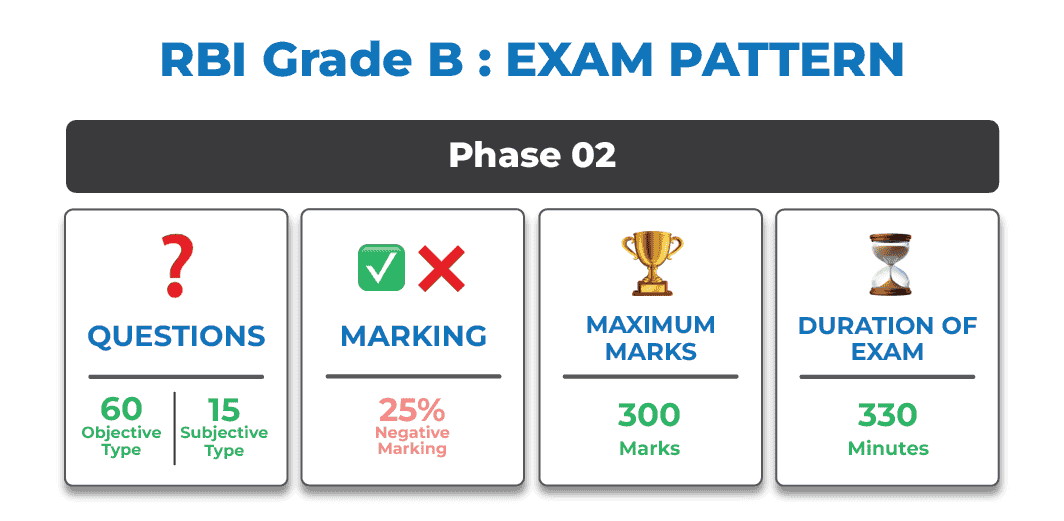
- Number of Questions: The RBI Grade B Phase 2 exam consists of a total of 60 objective-type questions and 15 subjective-type questions.
- Total Marks: The total marks for the exam are 300 marks, with each paper carrying 100 marks.
- Time Duration: The total duration allocated to complete the exam is 330 minutes.
- Exam Mode: RBI Grade B Phase 2 exam mode is as follows:
- The objective papers are conducted online in a computer-based format.
- The descriptive paper is conducted online, where you will have to write your answers on a computer.
- Negative Marking: There will be a negative marking of 1/4th marks for each incorrect answer in the objective papers while In the descriptive paper there is no negative marking as it is subjective paper.
- Cut-off Criteria: You must clear the overall cut-offs for all three papers (ESI, FM, and English) to qualify for the interview.
Important thing to Remember:
- The cut-offs change every year based on the highest marks scored by the candidates.
📌Anuj Jindal Insights
- Focusing on descriptive writing can give you an advantage in Phase 2 that is 2/3rd of total marks come from descriptive sections. For example, 200 out of the total 300 marks in Descriptive Writing do not have negative marking.
- The Phase 2 exam takes 5 hours 30 minutes across 3 papers and its marks are included in final merit list.
What are the Important Details about RBI Grade B Phase 2 papers?
You must know the following details for each paper: Economic & Social Issues, English, Finance & Management. This information will help you strategize your preparation according to the Phase 2 exam pattern.
Paper I – Economic & Social Issues (ESI)
- Objective Section: There will be a total of 30 questions for 50 marks with MCQ questions carrying a mix of both 1 marks and 2 marks.
- Descriptive Section: Out of 6 questions, you have to attempt 4 questions including 2 questions carrying 15 marks each and 2 questions carrying 10 marks each.
Paper II – English (Writing Skills)
- Descriptive Type: English is fully descriptive in nature and you need to type the answers for all questions.
- Negative Marking: As the paper is fully descriptive with no objective questions, there will be no negative marking.
- Language: It is mandatory to write the English paper in the English language only.
Paper III – Finance & Management (FM)
- Objective Section: You will be provided with 30 questions that carry 50 marks in total. MCQ based questions will be there carrying a mix of both 1 marks and 2 marks.
- Descriptive Section: There will be 6 questions, out of which you have to attempt (only 4 including 2 questions carrying 15 marks each and 2 questions carrying 10 marks each.
Important Pointer –
- In case, candidate answers more than 4 questions in descriptive, the first 4 shall be evaluated.
- You will have to type your answers on the computer, and you can choose to type in Hindi using either the Inscript or Remington (GAIL) keyboard layout.
| RBI Grade B Phase 2 Exam Pattern | |||
|---|---|---|---|
| Paper | No. of Questions | Time Duration | Marks |
| Paper 1: Economic and Social Issues | Objective - 30 Questions | 30 minutes | 50 |
| Descriptive - 6 Questions (to be attempted - 4) | 90 minutes | 50 | |
| Paper 2: English (Writing Skills) | Descriptive - 3 Questions (Precis, RCs, & Essay) | 90 minutes | 100 |
|
Paper 3: Finance and Management (Objective & Descriptive Type Questions) | Objective - 30 Questions | 30 minutes | 50 |
| Descriptive - 6 Questions (to be attempted - 4) | 90 minutes | 50 | |
📌Anuj Jindal Insights
Before you start writing, it would be an effective strategy to read all 6 questions properly. Then, select the best 4 questions you are confident about in the descriptive paper.
Does RBI Grade B exam have Sectional Timing?
The RBI Grade B exam provides a sectional timing to complete each section within a fixed time limit. However, if you do not know about the exam structure then it can be a bit challenging for you to attempt the exam.
This is different from many other exams where candidates can freely switch between sections. When the allotted sectional time of the paper ends, you will be automatically moved to the next section.
Sectional Timing in Phase 1
In RBI Grade B Phase 1 pattern, you get different time limits to complete each section:
- General Awareness (GA): 25 minutes
- Reasoning Ability: 45 minutes
- English Language: 25 minutes
- Quantitative Aptitude: 25 minutes
You can practice time and speed management so that you can complete the sections in the durations.
Sectional Timing in Phase 2
In RBI Grade B Phase 2 pattern, you get different time limits for each section:
- Descriptive English: The total time allotted for the Descriptive English paper in Phase 2 is 90 minutes, with no sectional timing for this.
- Finance and Management (FM): In the objective section, you will be given 30 minutes to complete the paper while 90 minutes is provided for the descriptive section.
- Economic and Social Issues (ESI): For the objective section, you will have the time limit of 30 minutes and the descriptive section allows you 90 minutes to finish the paper.
In Phase 2, there is no sectional time limit in Descriptive English as there are no sections or division unlike ESI and FM. You are required to complete the paper within the allotted time.
How Does Negative Marking Scheme work in RBI Grade B?
The RBI Grade B exam follows a structured marking scheme for incorrect answers in its objective papers. When you are answering questions, it is very important to pick the right option carefully to avoid any deduction of marks.
Below is a detailed explanation of the negative marking scheme applicable across different stages of the exam:
Phase 1 (Prelims) –
- Correct Answer: In the RBI Grade B Phase 1 exam, you get 1 mark for each correct answer.
- Incorrect Answer: For each incorrect answer, 0.25 marks (or 1/4th of the marks assigned to a question) will be deducted,
- Unattempted Questions: You will not be penalized, and no marks are deducted for questions you don’t attempt.
Phase 2 (Mains) –
- Objective Papers (ESI & FM):
- Negative Marking for 1-mark Questions: If the question is of 1-mark, 0.25 marks are deducted for each wrong answer.
- Negative Marking for 2-mark Questions: If the question is of 2-mark, 0.50 marks are deducted for each incorrect answer.
- Descriptive Papers (English, ESI & FM):
- Descriptive Section: No negative marking is there in the descriptive papers as your answers are evaluated based on clarity of expression, structure, and effective presentation of ideas.
To ensure the successful submission of your registration form, you can refer to RBI Grade B steps to apply online and learn about the application process in detail.
RBI Grade B Negative Marking Calculation: Case Study
Negative marking is an important aspect of the exam and I believe that many candidates fail to qualify Phase 1 because of ineffective strategy.
For example, a student attempted 125 questions out of 200 questions with moderate difficulty level in Phase 1 exam. So, he tried to maximize his attempts.
“Generally, candidates think that attempting more questions would fetch them with more marks but in reality, it does not happen”.
Now, let’s discuss his final score after deduction and section-wise division of incorrect answers:
| Subject-Wise Negative Marking | |
|---|---|
| General Awareness | If there were 6 incorrect answers, it would cause a penalty of 1.5 marks when 0.25 is multiplied by 6. |
| Quantitative Aptitude | In this subject, 10 wrong answers resulted in the total deduction of 2.5 marks when you multiply 0.25 with 10. |
| Reasoning | In this paper, 12 incorrect answers cut a total of 3 marks calculated as 0.25 × 12. |
| English | As 2 wrong answers resulted in a deduction of 0.5 marks, it is calculated as 0.25 × 2. |
His total deduction in Phase 1 was 7.5 marks, which includes the negative marks of each section i.e. 1.5 + 2.5 +3 +0.5. It simply means that the total penalty was 7.5 marks in his overall Phase 1 score.
👉 Negative Marking Formula: Incorrect Answers × 0.25 = Penalty
🎯 Summary of Exam
Let’s look at the details on questions attempted, correct and incorrect answers:
- No. Of Questions:The candidate attempted a total of 125 questions out of 200.
- No. Of incorrect answers: If a total of 30 answers were incorrect.
- No. Of correct answers: If he attempted 95 correct answers, his score became 95.
Let’s understand the process of Marking Scheme:
- Questions Attempted: The candidate attempted 125 questions out of which, there were 30 incorrect answers. Now, the total number of correct questions is 95 if we subtract 30 from 125.
- Extra Marks Penalty Impact: If there were 30 wrong answers, there is an extra penalty of 7.5 marks. Now if we calculate the total penalty, it’s 37.5 when 30 is added to 7.5.
- Actual Score: The actual score of the candidate after penalty will be 87.5, i.e. 95 minus 7.5.
👉 Final Score Calculation Formula: Total Attempted Questions − (Incorrect Answers + Extra Penalty)
Negative marking is something that you cannot ignore in the RBI Grade B exam. Many times, you fail to move to Phase 2 only because of a few incorrect answers. So, consider negative markings seriously.


Which Languages options are available for the RBI Grade B Phase 1 & 2 exams?
For the RBI Grade B exam, both Phase 1 and Phase 2 papers are bilingual which means that they are available in both English and Hindi (except the English Language section).
Candidates have the option to choose their preferred language at the beginning of the paper and can switch between the two languages during the exam.
Phase 1 (Prelims)
- General Awareness, Reasoning Ability, and Quantitative Aptitude are bilingual exams which includes Hindi and English languages.
- The English Language section can only be attempted in English.
Phase 2 (Mains)
- Paper II English (Writing Skills) can be attempted only in English while the Paper I (ESI) and Paper III (F&M) are both bilingual papers.
- In the descriptive papers, candidates can choose to type their answers in Hindi using either the Inscript or Remington (GAIL) keyboard layout.
What is the pattern of the RBI Grade B Interview Round?
RBI Grade B Interview is the third and final stage of the exam process. The interview round will be held after you subsequently clear the Phase 1 and Phase 2 exams.
- Minimum Cut-offs: The applicants who clear the Phase 2 overall cut off will be called for the interview round.
- Total Marks for Interview: The RBI Grade B Interview constitutes a total of 75 marks and carries the weightage of 20% in the final selection. It’s calculated out of 375 marks and that means 300 from Phase 2 + 75 from the interview.
- Selection Ratio: It generally revolves around 3:1 and means that 3 candidates are interviewed for every 1 vacancy.
- Duration: The interview duration usually ranges between 20 to 45 minutes.
- Language Choice: The candidates have an option to choose the interview language, i.e., either Hindi or English as per their convenience.
- Interview Panel: There is a 5-6 member panel of experts including senior officers who ask questions based on your educational qualifications, professional qualifications, interests and work experience.
- Interview Experience: The panel of experts in the interview is supportive. When stuck, you can switch language between English and Hindi. Your conceptual clarity matters more than language expertise.
RBI Interview Tie Breaking Rules
These rules apply if two or more candidates secure the same aggregate marks and the ranking is determined by the following factors:
- Phase 2 Score: If two candidates secure the same final score, then the one with higher Phase 2 marks is ranked higher.
- Educational Qualification: If their Phase 2 marks are also the same then the candidate with the higher educational qualification is given preference.
- Graduation Degree: If qualification is also the same, then a candidate with the highest marks in graduation degree is given priority. Make it absolutely direct.
- Age: If both candidates have the same level of graduation degree then the older candidate (by age) is given preference.
What Type of Questions are Asked in RBI Grade B Interview?
While there is no official and publicly shared information on RBI Grade B Interview questions, many candidates who successfully cleared the interview share their experiences and types of questions asked. Discussed below are the important aspects of RBI Grade B Interview questions:
- Educational Questions and Interests: You will be asked questions based on your academic qualifications, hobbies and work experience only if you have any job background.
- RBI-Specific Topics and Banking Questions: They ask questions related to RBI’s role in Indian Economy, functions, policies and initiatives.
- Economics, Finance, and Current Affairs Questions: You will be evaluated with questions related to your understanding of economic trends, financial developments in India and consequences of global economic policies on Indian Economy.
- Situational and Behavioral Awareness-based Questions: Your ability to handle stress, moral confusions, internal conflicts will be judged with questions based on different situations.
- Opinion-Based Questions: The panelists may ask you to share your views and opinions on specific topics such as current economic policies, problems and impact on Indian Economy.
Is the RBI Grade B Psychometric Test Mandatory for Candidates?
The candidate shall be required to undergo a Personality Assessment conducted by the bank before appearing for the Interview. No marks will be allotted for the same and it will not form part of the final selection criteria.
- Mandatory but non-graded: While it is compulsory for all shortlisted candidates, it carries no marks and does not affect your final selection. It works as a support system for the interview panel to evaluate your personality.
- Mode: The psychometric assessment is conducted online, allowing you to complete it from home.
- Options of Language: The test can be taken in English or any of the 9 other Indian languages that you prefer.
- Number of Questions: There will be around 100-120 questions designed to evaluate your personality and behavior.
- Marks: No points are allotted for the psychometric test.
- Time Limit: The test usually takes 15 to 20 minutes to complete. While there’s no strict time limit, the system tracks your time, which will be included in the final report.
- Purpose: It assesses your personal thinking, intelligence, inclinations, leadership, and decision-making skills.
- Panel Insight: The psychometric test results are provided to the panel before your interview. They refer to this information to evaluate your personality and behavioral qualities.
- Logic Behind Psychometric Test: The RBI wants to familiarize itself with your thinking patterns, agreements, disagreements, and reactions to a particular situation or event.
If you wish to know which documents you must carry to the exam hall, you can go through the RBI Grade B admit card and read important instructions.
RBI Grade B 2027 Final Selection
The final selection for RBI Grade B 2027 is determined by combining the scores from Phase 2 and the Interview, along with current rules.
To increase your chances of being selected as an RBI Grade B officer, it’s essential to perform well in both Phase 2 and the Interview.
The official list of selected candidates will be released on the RBI website, typically within 3-4 weeks after the completion of the interview process.
How Final Selection is Calculated
- The final merit is calculated from a total of 375 marks.
- The scores from the objective and descriptive parts of Phase 2 papers are combined and then added to the Interview marks.
- Marks obtained in Phase 1 are not counted in the final selection. The RBI Grade B Phase 1 exam is qualifying in nature.
RBI Grade B Final Selection – Case Study & Marks Analysis
In the RBI Grade B Exam, final selection plays an important role in determining whether a candidate makes it to the selection merit list.
I recall a student joining my class, he was not an outstanding performer in mock tests.
And he told me this “Sir, I have no grasp on complex topics of ESI”.
But he focused on all the papers, rather than focusing exclusively on one paper he was unsure of, he gave equal importance to all the papers.
When the final result came out, his scores were:
| Final Marks Breakdown | |
|---|---|
| Economic and Social Issues (ESI) | 62.5 |
| English Descriptive (Writing Skills) | 74.5 |
| Finance & Management | 71 |
| Personality Test/Interview | 55 |
| Total Score | 263 |
Let’s discuss how the final marks are calculated.
- In the RBI Grade B Exam, the final merit selection considers Phase 2 (300 marks) + Interview (75 marks) = 375 marks.
- While his Phase II total marks he scored were 208 (62.5+ 74.5 + 71) and in the interview, he got 55 marks.
So, what actually happened when his Phase 2 marks is added to his interview marks?
When you add Phase 2 final marks, which is 208 and 55 marks from his interview, now the final score becomes 263 out of 375.
In the RBI Grade B Exam, the final marks you score are an addition of Phase 2 marks and the interview marks, and it determines your selection in the final merit selection list.
Conclusion
Now that you’re familiar with the RBI Grade B exam pattern, as well as weightage, time limit, negative marking, language options, and total marks of all phases.
Stay motivated and keep pushing forward!

About Anuj Jindal
━━━━━
Anuj Jindal, the founder, is an ex-manager from SBI, with an M.Com from Delhi School of Economics. He also has a JRF in Commerce & Management and NET in HRM, along with more than 5 years of experience in the field of Education.
Anuj Jindal RBI Grade B Course:
- 2027 Live Batch with Live Doubt Sessions
- 30-Day Live Revision Batch
- 3 Physical Practice Books
- 1 to 1 Interview Guidance Programme
- 250+ Videos Lessons & 150+ Notes
- 2500+ Practice Ques. + 60 Full-Length Tests
- Comprehensive Current Affairs coverage

FAQ: RBI Grade B Exam Pattern
- What are the total allocated marks for the Phase-I General Exam?The total allotted marks for RBI Grade B Phase-I (General) is 200 marks.
- What is the time duration of the RBI Grade B Phase-I & Phase 2 exam?
The time duration of the RBI Grade B Phase-I exam is 2 hours (120 minutes). The Phase 2 comprises of 3 papers –
- Paper 1: Economic and Social Issues (ESI) for 120 minutes
- Paper 2: English Descriptive for 90 minutes
- Paper 3: Finance and Management for 120 minutes.
- Is the RBI Grade B exam Bilingual?
Yes, the RBI Grade B exam papers are bilingual (available in both English and Hindi), with the exception of the English Language sections:
- Phase 1: General Awareness, Reasoning Ability, and Quantitative Aptitude are bilingual, while English Language is available only in English.
- Phase 2: Paper 1 (ESI) and Paper 3 (FM) are bilingual, while Paper 2 (English Writing Skills) must be attempted entirely in English.
- Is there any negative marking in the RBI Grade B Exam?
Yes, negative marking applies to all objective questions across Phase 1 and Phase 2:
- Phase 1: A penalty of 0.25 marks (1/4th of 1 mark) is deducted for each incorrect answer.
- Phase 2 (Objective ESI & FM): 0.25 marks are deducted for 1-mark questions, and 0.50 marks are deducted for 2-mark questions.
- Descriptive Papers: There is no negative marking for descriptive answers. Unattempted questions carry no penalty.
- How many marks is the RBI Grade B Interview for?RBI Grade B Interview constitutes a total of 75 marks and carries the weightage of 20% in the final selection.
- What is the weightage of the RBI Grade B Interview?
The RBI Grade B interview carries a 20% weightage in the final merit list. Final selection is based on a total of 375 marks, combining Phase 2 (300 marks) and the interview (75 marks), which results in a 20% interview contribution (75/375).
- What are the total marks for the RBI Grade B Exam?
The RBI Grade B selection process consists of three stages:
- Phase 1: 200 marks (qualifying only; not included in final merit)
- Phase 2: 300 marks (3 papers of 100 marks each)
- Interview: 75 marks, as only Phase 2 and interview marks count toward final selection; the total score considered for the final merit list is 375 marks.
- Are there minimum qualifying marks in RBI Grade B?No, there is no minimum qualifying or passing marks in both Phase 1 and Phase 2 of RBI Grade B exam.
- Sectional Cut-off: RBI declares cutoffs for each section in both Phase 1 and Phase 2 which you must clear.
- Overall Cut-off: Also, there is an overall cutoff for both Phase 1 and Phase 2, and it is essential for you to clear it to move to the next stage of selection process.
Always Remember: The cut-offs change every year based on the number of applicants, the highest scoring marks, and other factors.
- Is RBI grade B MCQ based?While Phase 1 of RBI grade B exam is completely MCQ based, Phase 2 has both objective and descriptive papers.
- Phase 1: All questions are completely based on MCQ.
- Phase 2: While it also has MCQ based questions, it has a mixed pattern as descriptive questions are also asked in Paper 1 and Paper 3. Additionally, English paper is fully descriptive with no MCQ based questions.
- What are the sections included in the RBI Grade B Phase 1 exam pattern?There are 4 sections in the RBI Grade B Phase 1 exam:
- General Awareness: In the GA section, 80 questions are asked from subjects such as current affairs, banking and financial awareness, static GK etc.with a sectional time limit of 25 minutes.
English: You will be asked 30 questions from RCs, grammar, vocabulary, etc. with a time limit of 25 minutes to complete the paper. - Quant: In this section, you will be required to answer 30 questions based on numerical problems, data interpretation, simplification, and quadratic equations, within 25 minutes.
- Reasoning: You will have 60 questions to answer from areas such as puzzles, seating arrangement, syllogism, coding-decoding, etc. And the time limit is 45 minutes.
- General Awareness: In the GA section, 80 questions are asked from subjects such as current affairs, banking and financial awareness, static GK etc.with a sectional time limit of 25 minutes.
- Where can I find official information about the RBI Grade B exam pattern?You can find detailed information about the RBI Grade B exam pattern at the following places:
- RBI Website: It has comprehensive details on the official RBI website with the latest information.
- Recruitment Notification PDF: The recruitment notification mentions complete details on sections, weightage, and the overall RBI Grade B exam pattern.
- Anuj Jindal website: Our website provides detailed, updated, and latest information about the RBI Grade B exam pattern.
- Which is the toughest subject in RBI Grade B?In the RBI Grade B exam, Quantitative Aptitude is usually considered the toughest subject by many candidates because of the following reasons:
- Concept-based: Questions in this section require strong conceptual clarity and understanding.
- Time Taking/Consuming: Given the sectional time limit of 25 minutes for this section, you need to be accurate and quick with numbers. Additionally, mathematical calculations require mental ability, and any inaccuracy leads to incorrect answers.
The solution to deal with Quant effectively is to practice more numerical questions with a timer, repeat it and then practice again and again. You must have heard the saying “Practice makes everyone perfect.”
- Is the RBI Grade B exam online or offline?The RBI Grade B exam is conducted completely in online mode, and it’s a computer-based exam for both Phase 1 and Phase 2 with sectional time limits for each paper.
For objective papers, you will have to select the correct answer from the options available on the screen. In the Descriptive papers of Phase 2, you are required to type your answers on the keyboard. Even the mandatory Psychometric Test before the interview is conducted online.
- What are the Phase 1 sections and their weightage?The RBI Grade B Exam is structured into two important phases: Phase 1 and Phase 2. While Phase 1 is qualifying in nature, Phase 2 marks are added for the final merit list of selection.
Phase 1 – It has 4 sections, and each question in every section carries 1 mark.
- General Awareness (80 questions)
- Reasoning Ability (60 questions),
- English Language (30 questions) and
- Quantitative Aptitude (30 questions)
There is a sectional time limit for each section, and you must clear the sectional cut-of along with the overall Phase 1 cutoff to qualify for the next phase.
- Does Phase 1 count towards final selection?No, the RBI Grade B Phase 1 Exam is only a qualifying exam, and your marks are not added in final selection. Your marks in Phase 2 and the interview are added for final merit selection.
- How are descriptive answers submitted?You will have to type the answers to descriptive questions on the keyword in the Phase 2 exam that includes descriptive sections along with objective questions.
- Can I attempt more than the required descriptive questions?You are required to attempt 4 descriptive questions out of 6 in both ESI and FM. If you attempt more questions than actually required, only the first 4 questions (2 from each category) will be considered for evaluation.
- What is the psychometric test?The psychometric test is a mandatory test that shortlisted candidates must complete before the interview. It is conducted in an online mode that evaluates your personality, behavior, critical thinking, and decision-making skills.
- How does Anuj Jindal’s free study material help with RBI Grade B preparation?
Anuj Jindal’s free study material provides carefully compiled notes, videos, and resources that help aspirants cover the syllabus and prepare effectively for both Phase 1 and Phase 2.